
FemiCore vs Uqora: Which Urinary Health Supplement Should You Choose?
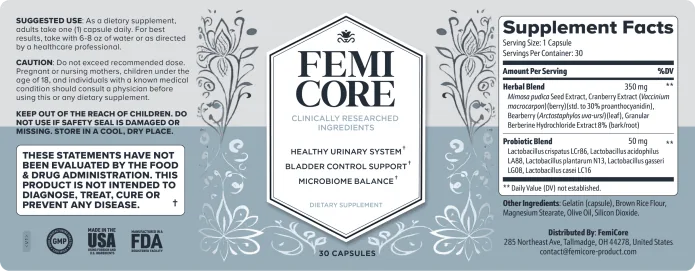
FemiCore and Uqora are the two names women most often weigh up for recurring urinary problems, and they are designed very differently. Uqora is a system of separate products built mainly around D-mannose. FemiCore is a single daily capsule built around standardized cranberry, antimicrobial botanicals and five Lactobacillus strains, and it contains no D-mannose. Neither is clearly "better"; they suit different situations and budgets.
Uqora updates its range and pricing from time to time. Check the current labels on its website before buying.
What each brand offers
| Uqora | FemiCore | |
|---|---|---|
| Format | Three products, sold separately or as a bundle | One capsule |
| Flush-type product | A drink mix based on D-mannose with vitamin C and electrolytes, used after triggers such as sex or exercise | None |
| Daily prevention | A daily capsule based on D-mannose with botanical extracts | Cranberry extract (30% PACs), bearberry, berberine, mimosa pudica |
| Probiotic | A separate daily vaginal probiotic with Lactobacillus strains | Included in the same capsule: L. crispatus, acidophilus, plantarum, gasseri, casei |
| Doses per day | Two capsules plus a drink as needed | One capsule each morning |
| Main anti-adhesion compound | D-mannose | Cranberry proanthocyanidins |
The key difference: D-mannose versus cranberry PACs
Both compounds aim to stop E. coli sticking to the bladder wall, by blocking different bacterial "hooks".
- D-mannose had encouraging early results, including a 2014 trial in which 2 g daily performed about as well as a low-dose antibiotic. A larger 2024 UK primary-care trial, however, found no reduction in recurrent UTIs compared with placebo. The evidence is now mixed.
- Cranberry PACs are supported by a 2023 Cochrane review of 50 trials, which found cranberry products reduce symptomatic UTIs by roughly a quarter in women with recurrent infections.
Uqora delivers a clear, high D-mannose dose. FemiCore's label states its cranberry extract is standardized to 30% PACs but does not give the milligram amount inside its 350 mg herbal blend.
Probiotics compared
Both brands include Lactobacillus strains for the vaginal microbiome. The species most strongly linked to protection against recurrent UTIs is Lactobacillus crispatus, and FemiCore lists it first in its blend, alongside L. gasseri, another vaginal-origin species. Check which strains the current Uqora probiotic lists, and whether it states a CFU count; FemiCore gives only a 50 mg blend weight. Strain detail for FemiCore is in FemiCore Lactobacillus.
Cost
| Uqora | FemiCore | |
|---|---|---|
| Entry cost | One product, roughly $30 a month | 2 bottles: $158 + $9.99 shipping |
| Full routine | Complete system roughly $60–$80 a month, less on subscription | $49–$79 per bottle depending on package |
| Purchase model | One-off or subscription | One-off only, no auto-ship |
| Guarantee | Check current returns policy | 60 days from delivery; all bottles and the packing slip must be posted back at your cost |
On a like-for-like basis (daily prevention plus probiotic) the two cost about the same. Uqora lets you start small with a single product; FemiCore's smallest order is two bottles.
Convenience and tolerability
- Uqora: more steps, but flexible. You can use the flush product only around triggers. D-mannose at high doses can cause loose stools; people with diabetes should monitor blood sugar.
- FemiCore: one capsule, nothing to mix. Mild bloating is possible in week one. It is not recommended in pregnancy or breastfeeding because of berberine and bearberry, and both berberine and cranberry can interact with diabetes medication and warfarin. See FemiCore safety.
Who should choose Uqora
- Your infections are clearly trigger-related, for example after sex, and you want something to take at that moment.
- You want D-mannose specifically and at a known dose.
- You are pregnant or breastfeeding and your doctor is comfortable with D-mannose.
- You prefer to start with one inexpensive product.
Who should choose FemiCore
- You want the simplest possible routine.
- D-mannose has not worked for you.
- You also have urgency, frequency or night-time trips between infections, which suggests a wider microbiome issue. See FemiCore for leaks.
- You specifically want L. crispatus and a standardized cranberry extract in one product.
- You dislike subscriptions.
Can you combine them?
There is no need to take both full systems. The sensible combination, if you want one, is FemiCore daily with a D-mannose product around triggers, since FemiCore contains no D-mannose and the two do not overlap. We cover that in FemiCore D-mannose.
Verdict
Choose on mechanism and lifestyle, not on marketing. Uqora is the flexible, D-mannose-centred system with a low entry price. FemiCore is the one-capsule, cranberry-plus-probiotic option with L. crispatus built in and no subscription. If your main goal is fewer recurring infections and you have not tried D-mannose, Uqora or plain D-mannose is a fair first step. If you want microbiome support and bladder-comfort benefits in a single capsule, FemiCore is the stronger fit. Packages are on our FemiCore cost page.
This article is for information only and is not medical advice. Uqora is a trademark of its owner; this site is not affiliated with Uqora and may earn a commission on FemiCore purchases.

60-day money-back guarantee · Bottles from $49 · Ships to US, CA, UK, IE, AU, NZ